
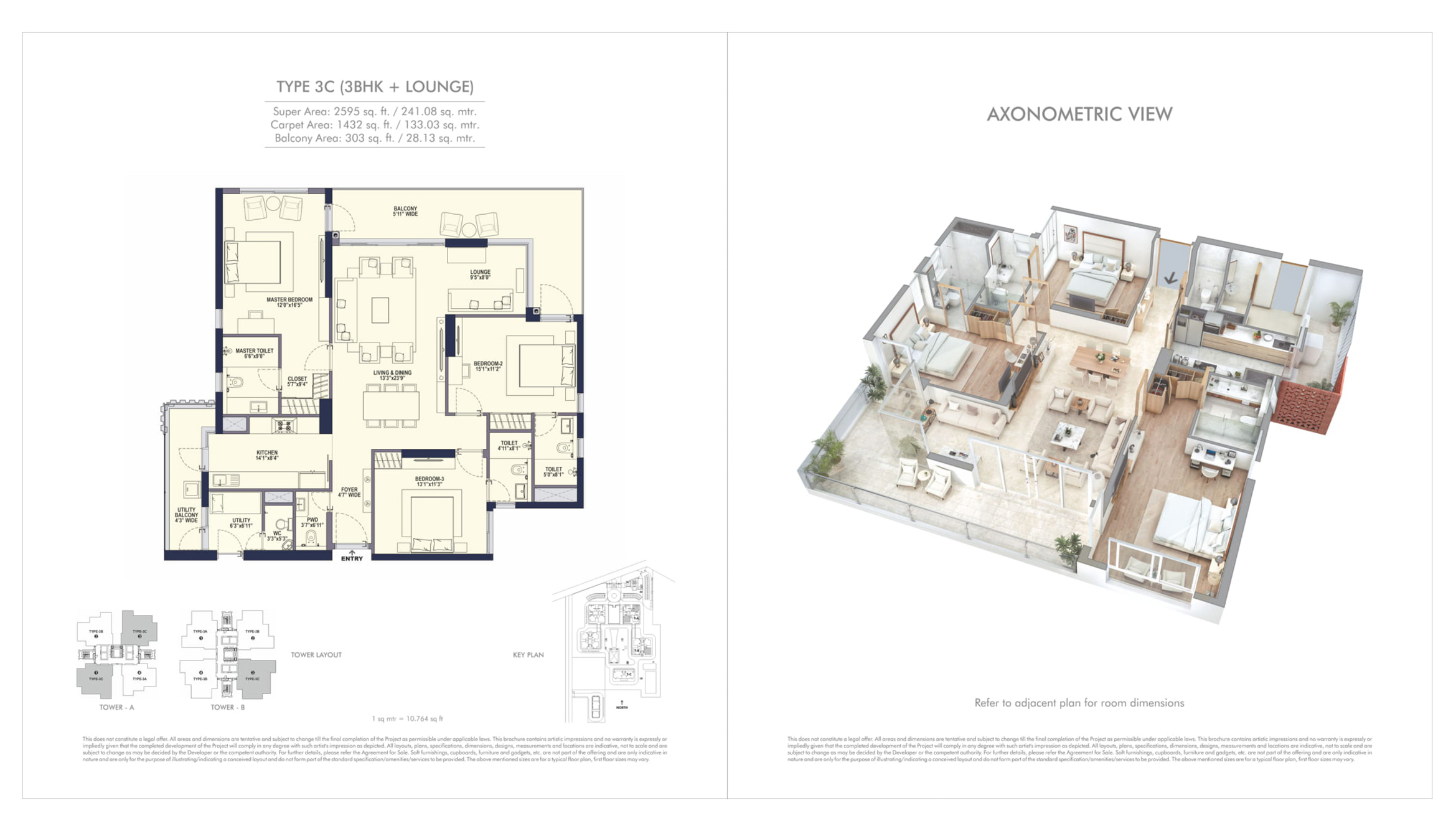
You find a flat you like. The brochure says 1,200 sq ft. You visit the property and it feels much smaller than you expected. You are not wrong — the number in the brochure was probably the super built-up area, which includes corridors, lift shafts, and common lobbies that you will never use as living space.
This is one of the most common ways home buyers in India end up confused — and sometimes cheated — before RERA came into force.
Understanding the difference between carpet area, built-up area, and super built-up area is not a technical detail. It directly affects how much space you actually get, how much you are really paying per square foot, and whether you are comparing two properties on equal terms.
Carpet Area and Super Built-Up Area
Carpet area is the actual usable floor area inside a property where you can place furniture or lay a carpet. Super area, also called super built-up area, includes carpet area plus wall thickness, balconies, and a share of common areas such as lifts, lobbies, staircases, and clubhouse facilities.
What Is Carpet Area and Super Area?
When buying a property, many buyers get confused by terms such as carpet area, built-up area, and super area. Builders often advertise large apartment sizes, but the actual usable living area may be much smaller.
Understanding the difference between carpet area and super area is important because it directly affects the price you pay and the actual living area you receive.
For example, two apartments may both be advertised as 2,000 sq. ft., but one could offer much larger usable living space than the other because of different loading factors.
This is why smart homebuyers always compare properties based on carpet area before making a decision.
Premium residential projects from trusted developers such as Conscient Hines Elevate usually provide clear area details, helping buyers understand exactly what they are paying for.
What Is Carpet Area?
Carpet area is the actual usable area inside your apartment.
In simple words, it is the area where you can place furniture, walk freely, or lay a carpet.
According to real estate rules, carpet area includes the usable floor inside the apartment walls.
Carpet Area Includes
- Bedrooms
- Living room
- Kitchen
- Bathrooms
- Dining area
- Internal passage area
Carpet Area Does Not Include
- External walls
- Balcony area
- Terrace
- Lift area
- Staircase
- Clubhouse
- Shared corridors
Think of carpet area as the real living area you physically use every day.
If you buy a 1500 sq. ft. apartment but only 1050 sq. ft. is carpet area, then 1050 sq. ft. is your usable living area.
What Is Super Area?
Super built-up area — also called saleable area — is the largest of the three figures. It adds your proportionate share of all common areas in the building to the built-up area.
What Gets Added to Make Super Built-Up Area:
- Lift shafts and machine rooms
- Staircases
- Common lobbies and entry corridors
- Security cabins
- Clubhouse and gym (in some projects)
- Swimming pool area (in some projects)
- Utility rooms and storage
Super Built-Up Area Formula
Super Built-Up Area = Built-Up Area + Proportionate Share of Common Areas
Or more simply:
Super Built-Up Area = Carpet Area × (1 + Loading Factor)
Super built-up area is typically 25–50% more than carpet area, depending on how many amenities the project has and how the developer calculates the loading.
Example: Carpet area = 1,000 sq ft Loading factor = 40% Super built-up area = 1,000 × 1.40 = 1,400 sq ft
This means if you buy a flat listed at 1,400 sq ft super built-up area, you are getting approximately 1,000 sq ft of actual usable living space.
What Is Built-Up Area?
Built-up area is the next level up from carpet area. It includes everything in the carpet area plus the space taken up by walls and balconies.
Built-Up Area Formula
Built-Up Area = Carpet Area + Thickness of Walls + Balcony Area
Built-up area is typically 10–20% more than carpet area.
Example: If the carpet area is 1,000 sq ft, and walls + balcony add 150 sq ft: Built-up area = 1,000 + 150 = 1,150 sq ft
Built-up area represents the total footprint of your individual flat — everything that is yours exclusively, including the walls and private outdoor spaces like a balcony.
In simple terms, the built-up area is still YOUR space — exclusive to your flat. It does not include any shared or common areas of the building. That comes next.
Carpet Area vs Super Area: Main Difference
The biggest difference is simple:
Carpet area shows actual usable living area, while super area includes shared and non-usable areas.
| Feature | Carpet Area | Super Area |
| Meaning | Actual usable area | Total saleable area |
| Includes Walls | No | Yes |
| Includes Balcony | No | Yes |
| Includes Shared Areas | No | Yes |
| Real Living Space | Yes | No |
| Used for Pricing | Rarely | Mostly |
When comparing apartments, buyers should focus more on carpet area because it tells the real home size.
Side-by-Side Comparison: All Three Area Types
| Feature | Carpet Area | Built-Up Area | Super Built-Up Area |
| What it includes | Usable space inside your flat | Carpet area + walls + balcony | Built-up area + share of common areas |
| Exclusive to you? | Yes | Yes | No — includes shared spaces |
| Used for pricing (post-RERA) | Yes — mandatory | Sometimes | No longer mandated |
| Typical size relationship | Smallest | 10–20% more than carpet | 25–50% more than carpet |
| Best for | Comparing actual living space | Understanding your flat’s footprint | Pricing context (pre-RERA era) |
| Legal reference | RERA Section 2(k) | General real estate practice | General real estate practice |
Why Carpet Area Matters More for Buyers?
Many first-time buyers only see the apartment size shown in brochures and assume that entire area belongs to them.
But the truth is different.
Suppose:
| Apartment | Super Area | Carpet Area |
| Flat A | 2000 sq. ft. | 1450 sq. ft. |
| Flat B | 2000 sq. ft. | 1650 sq. ft. |
Even though both apartments look equal on paper, Flat B gives much more usable living area.
This is why carpet area matters more than super area.
Benefits of Checking Carpet Area
- Better understanding of actual living size
- Easier property comparison
- Smarter pricing evaluation
- Better resale understanding
- Improved value for money
How to Calculate Carpet Area?
Carpet area calculation is simple.
You add the usable floor areas inside the apartment and remove wall thickness.
Carpet Area Formula
Carpet Area=Usable Room Areas−Wall Thickness\text{Carpet Area} = \text{Usable Room Areas} – \text{Wall Thickness}Carpet Area=Usable Room Areas−Wall Thickness
Example
Suppose a flat has:
- Bedroom = 300 sq. ft.
- Living room = 350 sq. ft.
- Kitchen = 150 sq. ft.
- Bathrooms = 120 sq. ft.
- Internal passage = 80 sq. ft.
Total usable area becomes:
300 + 350 + 150 + 120 + 80 = 1000 sq. ft.
This becomes the carpet area.
How to Calculate Super Area?
Super area includes extra shared parts of the building.
Super Area Formula
Super Area=Carpet Area+Common Area Share+Wall Area+Balcony Area\text{Super Area} = \text{Carpet Area} + \text{Common Area Share} + \text{Wall Area} + \text{Balcony Area}Super Area=Carpet Area+Common Area Share+Wall Area+Balcony Area
Another common formula is:
Super Area=Carpet Area×(1+Loading Factor)\text{Super Area} = \text{Carpet Area} \times (1 + \text{Loading Factor})Super Area=Carpet Area×(1+Loading Factor)
Example
- Carpet area = 1000 sq. ft.
- Loading factor = 30%
Calculation:
1000 × 1.30 = 1300 sq. ft. super area
What Is Loading Factor in Real Estate?
Loading factor means the extra percentage added to carpet area to calculate super area.
It includes the cost of common areas and shared facilities.
Standard Loading Factor in India
| Project Type | Loading Factor |
| Budget Housing | 20–25% |
| Premium Apartments | 25–35% |
| Luxury Projects | 35–45% |
In luxury projects, loading can sometimes be higher due to large clubhouses and premium facilities.
Why Builders Use Super Area?
Builders mainly quote super area because it helps present a larger apartment size.
For example:
A flat with 1200 sq. ft. carpet area may become 1700 sq. ft. super area after loading.
This often makes buyers feel they are buying a larger home.
Still, smart buyers always ask:
“What is the carpet area?”
before finalising a property.
Premium projects from trusted developers like Conscient Hines Elevate generally provide better transparency regarding apartment sizes and specifications.
What Does RERA Say About Carpet Area?
Under RERA rules, builders must clearly mention carpet area in project details and property documents.
This rule was introduced to improve buyer transparency.
RERA Helps Buyers By
- Making carpet area mandatory
- Reducing confusion in pricing
- Improving builder transparency
- Helping buyers compare projects fairly
Because of RERA, buyers today can better understand what they are paying for.
Built-Up Area vs Carpet Area vs Super Area
Many buyers also hear the term built-up area.
Here is a simple comparison.
| Feature | Carpet Area | Built-Up Area | Super Area |
| Usable Space | Yes | Yes | Partial |
| Includes Wall Thickness | No | Yes | Yes |
| Includes Balcony | No | Yes | Yes |
| Includes Common Areas | No | No | Yes |
| Apartment Size | Smallest | Medium | Largest |
Simple Understanding:
- Carpet Area → What You Actually Use
- Built-Up Area → Carpet + Walls + Balcony
- Super Area → Built-Up + Shared Areas
Common Mistakes Buyers Make
Many homebuyers make mistakes because they only focus on total apartment size.
| Mistake | Result |
| Ignoring carpet area | Less usable home |
| Trusting brochure size only | Wrong expectations |
| Not checking loading factor | Higher cost |
| Comparing only super area | Poor comparison |
| Skipping RERA details | Less transparency |
A smart buyer always checks both carpet area and loading percentage before booking.
How to Calculate Carpet Area of a Flat You Are Visiting?
If you are visiting an under-construction or ready flat and want to check the carpet area yourself, here is a simple method:
- Measure the length and width of each room from wall surface to wall surface (inner dimensions)
- Multiply length × width for each room to get its area
- Add all room areas together: bedrooms + living area + kitchen + bathrooms + internal passages
- This is your usable carpet area
Note: RERA carpet area also adds internal wall thickness to this figure, which is why it is slightly higher.
You can also work backwards from the super built-up area:
Estimated Carpet Area = Super Built-Up Area ÷ (1 + Loading Factor)
If the loading factor is 35% and the flat is listed at 1,200 sq ft super built-up: Carpet area = 1,200 ÷ 1.35 = ~889 sq ft
How to Compare Two Apartments Correctly?
Suppose two builders offer:
Apartment A
- Super Area: 1800 sq. ft.
- Carpet Area: 1250 sq. ft.
Apartment B
- Super Area: 1700 sq. ft.
- Carpet Area: 1350 sq. ft.
Most buyers may choose Apartment A because it looks bigger.
But Apartment B actually gives more usable living area.
This shows why understanding carpet area and super area is important.
Which Area Should Buyers Focus On?
For homebuyers, carpet area should always be the top priority. Because that is the real area where daily life happens.
Super area matters for pricing, but carpet area matters for actual living comfort.
Buyers Should Check
- Carpet area percentage
- Loading factor
- Balcony size
- Common facilities included
- Builder transparency
- RERA details
Why Premium Projects Explain Area Better?
Luxury and premium residential projects often provide more detailed floor plans and clear measurement breakdowns.
Projects by trusted developers like Conscient Hines Elevate usually focus on better transparency, helping buyers understand apartment layouts, usable area, and facilities before purchase.
This helps reduce confusion and improves buying confidence.
RERA Rules: How They Protect Home Buyers
RERA has made two key changes that protect buyers from area-related confusion:
1. Pricing must be based on carpet area: Developers cannot quote prices on super built-up area anymore. All sale agreements and brochures must show the RERA carpet area and price accordingly.
2. Carpet area cannot increase by more than 3%: If a project is under construction and the final carpet area turns out to be larger than promised, the developer can only charge the buyer for up to 3% more. Any increase beyond 3% cannot be charged. If the area decreases, the developer must refund the excess with interest within 45 days.
3. Mandatory disclosure on RERA portals: All registered projects must list carpet area on their state RERA portal. Buyers can verify this independently before signing anything.
Tip: Before finalising any flat purchase, log on to your state RERA portal (e.g., hrera.org.in for Haryana, maharera.mahaonline.gov.in for Maharashtra) and verify the registered carpet area of the specific flat. Never rely only on the brochure.
How do I calculate carpet area from super built-up area?
Use this formula: Carpet Area = Super Built-Up Area ÷ (1 + Loading Factor). For example, if the super built-up area is 1,400 sq ft and the loading factor is 40%, carpet area = 1,400 ÷ 1.40 = 1,000 sq ft. You can also ask the developer directly for the RERA-registered carpet area, which all developers must provide by law.
What is the carpet area of a 1,500 sq ft flat?
If 1,500 sq ft is the super built-up area, the carpet area depends on the loading factor. At a 30% loading factor, carpet area = 1,500 ÷ 1.30 = ~1,154 sq ft. At a 40% loading factor, carpet area = 1,500 ÷ 1.40 = ~1,071 sq ft. Always ask the developer for the RERA carpet area figure — do not estimate alone.
What is a typical carpet area for a 1BHK flat?
In most Indian cities, a 1BHK flat has a carpet area between 350 sq ft and 550 sq ft. In Mumbai, smaller 1BHK units can be as low as 280–320 sq ft carpet area. In Gurgaon and Pune, newer 1BHK units typically start at 450–500 sq ft carpet area. Always check the RERA-registered carpet area rather than the super built-up number shown in ads.
What is carpet area in a flat?
Carpet area is the actual usable floor area inside a flat where you can place furniture and move around comfortably.
What is super area in real estate?
Super area includes carpet area plus wall thickness, balconies, and a share of common areas like lifts, corridors, and clubhouse facilities.
Is 1,000 sq ft carpet area good for a family?
Yes, 1,000 sq ft of carpet area is comfortable for a small family of three or four. This typically corresponds to a 2BHK or a large 2BHK with a study. For context, at a 35% loading factor, a 1,000 sq ft carpet area flat would be listed as approximately 1,350 sq ft super built-up area in the brochure.
Why is carpet area important?
Carpet area matters because it shows the actual living area available inside the property.
How to convert carpet area into super area?
Super area can be calculated by adding the loading factor to carpet area. For example, a 1000 sq. ft. carpet area with 30% loading becomes 1300 sq. ft. super area.
Conclusion
Understanding what is carpet area and super area is very important before buying property in India.
Carpet area represents the real usable floor area inside your home, while super area includes shared spaces, walls, balconies, and amenities.
Builders often quote prices based on super area, but smart buyers compare homes using carpet area to understand actual value.
Before booking any property, always check:
- Carpet area
- Super area
- Loading factor
- RERA details
- Builder transparency
A clear understanding of these terms helps buyers make smarter and safer property decisions.





No responses yet